Beyond the Will: Filling the Gaps in Your Estate Plan

Updated: Aug 13
Most estate plans don't fail because someone skipped a document. They fail in the space between the documents — and that space is usually easy to fix.
When someone tells me their estate planning is done, I usually ask one follow-up question: when did you last look at the beneficiary form on your 401(k)?
The answer is almost always some version of "I don't remember." Sometimes it's "I'm not sure I ever filled one out." That's not a knock on anyone. The form gets signed on your first day at a job, filed somewhere you'll never see again, and then life happens — a marriage, a divorce, kids, a new job — and nothing about it updates itself.
So we pull it up. Oftentimes, it says something the person didn't expect.
Most people aren't behind because they skipped a step
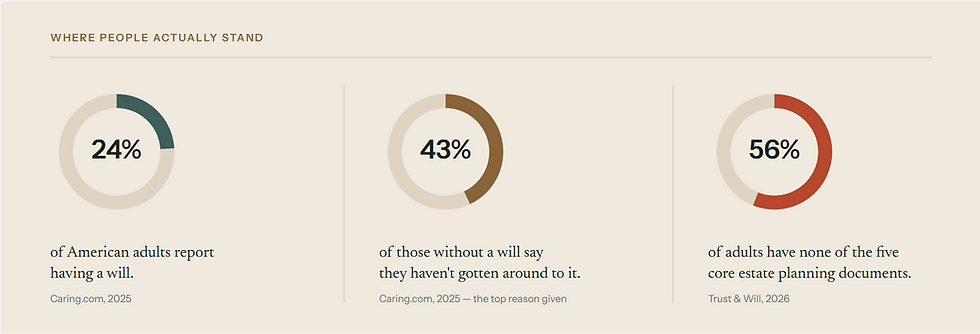
Caring.com asked people without a will why they didn't have one. The top answer wasn't cost, and it wasn't a sense that they had nothing worth passing on. They just hadn't gotten around to it — about two out of every five.1 A survey this past winter found 56% of adults have none of the five basic documents: no will, no trust, no financial power of attorney, no health care power of attorney, no HIPAA form.2
I get why. Every other financial deadline announces itself. Taxes are due in April. Open enrollment closes in December. Estate planning sends you nothing, so it waits.
But the group I worry about more is the one that already did the work. They signed documents in 2011 and haven't looked since. The will says one thing, an old 401(k) form says another, and no one in the family knows where any of it is. Here's what I'd actually check, roughly in this order.
One note before we start. I'm not an attorney or a CPA, and our firm doesn't give legal or tax advice. Which documents you need, and how they should be drafted and signed, are questions for an estate planning attorney licensed in your state. Tax questions belong with your CPA. What I can tell you is where these plans come apart, because I see them from the account side.
Start with the paperwork you'd use while you're still alive
The documents people skip most are the ones they're most likely to need. A will does nothing until you die. But an accident, a serious illness, or a slow cognitive decline can leave you unable to sign or decide for yourself — and that's more common than the scenario most people plan for.
The usual tools are a durable financial power of attorney, a health care power of attorney, a HIPAA authorization, and some form of advance directive. Your attorney will tell you which ones fit and how your state wants them signed. Two things I'd add from my side of the desk.
A power of attorney generally ends at death. It's built for incapacity, not for settling an estate. A lot of people assume it covers both. Once someone dies, authority to act comes from somewhere else entirely.
Not every institution treats these documents the same way. Some have their own forms. Some send yours to their legal department first, and that review is never fast. If you have a power of attorney, call each bank and custodian and ask whether they'll accept it.
Without these documents, a family facing a sudden illness usually ends up in court asking a judge to appoint someone — slower, costlier, more public, and at the worst possible moment.
Your will controls less than you think
This is the one that surprises people most.
A will directs assets that go through probate, and a lot of assets never get there. Retirement accounts, life insurance, annuities, and anything with a transfer-on-death or payable-on-death registration go straight to whoever is named on the form. Property held jointly with survivorship rights goes to the surviving owner automatically.
None of that is generally governed by your will. In most cases, when a beneficiary form and a will disagree, the form controls. There are narrow exceptions worth asking your attorney about — but don't count on a will to clean up a stale form.
This is where I find the most problems:
An ex-spouse still named. Divorce paperwork doesn't reliably reach every account, especially employer retirement plans. This has produced real court cases and real windfalls to former spouses.
No backup beneficiary. If your primary dies before you and nobody's named behind them, the money can fall back into your estate — pulling a fast, simple transfer into probate and shortening the payout window for whoever inherits.
"My estate" listed on a retirement account. Occasionally on purpose. Usually not. It generally produces the worst available tax treatment for your heirs.
Minor children named directly. An insurance company can't write a check to a child. Without a legal structure set up by an attorney to receive it, a court may have to step in to manage that money until the child turns eighteen.
Forgotten 401(k)s at old employers. Old plan, old form, old life, never revisited.
Most people have never seen all these forms in one place. Building that list — every account, primary and backup — is the most useful hour you can spend on any of this.
The expensive binder on your shelf
Here's a related problem, and one of the most costly I run into.
A trust only controls what it actually owns. Signing the document creates the container — it doesn't put anything inside. Moving assets in is a separate step: retitling accounts and property into the trust's name, or updating beneficiary designations to point to it where that's appropriate.
When that step doesn't happen, the trust is unfunded. The binder looks impressive on the shelf, the family assumes probate is handled, and the assets go through probate anyway — because as far as the county is concerned, the trust never owned them.
I see this most often when someone planned years ago and has opened new accounts since, or refinanced a house and the title came back in their personal name without anyone noticing. If you have a trust, confirm what's actually titled into it. Your attorney handles the retitling if needed.
The ten-year rule changed what your heirs actually receive
Naming the right person is only half of it. What happens on the other end has changed, and a lot of plans were built before it did.
Under the SECURE Act, most adult children and other non-spouse heirs have to empty an inherited retirement account within ten years. If the original owner had already started taking required withdrawals, the heir also has to take money out each year during that window — a rule the IRS began enforcing in 2025.3
In plain terms: ten years of taxable withdrawals, often landing on a child in their peak earning years. Naming a young beneficiary and letting the account stretch across their lifetime doesn't work the way it used to.
One thing worth raising with your CPA if charitable giving is already part of your plan: not all assets are equally painful to inherit. Pre-tax retirement accounts carry an income tax bill with them; assets that receive a basis reset generally don't. Families facing this sometimes look at which assets go to charity and which go to heirs, rather than splitting everything evenly across both. Whether it fits depends on your circumstances, so raise it with your tax professional and attorney.
Nobody can honor a plan they can't find
This is the failure almost every family runs into and nobody plans for. Your documents can be perfect and your forms flawless, and it still goes badly if the person in charge spends four months playing detective. What they need is one page telling them where things are:
Where the signed originals are, and who else knows
Every bank, brokerage, and retirement account — the institution, not the password
Insurance policies and the companies that issued them
Your attorney, CPA, and advisor, with phone numbers
The safe deposit box, and who's actually authorized on it
Bills that don't stop on their own: mortgages, subscriptions, storage units
Then there's the digital side, which matters more every year. Photos, email, airline miles, crypto, and the two-factor codes protecting all of it. A password manager with emergency access handles most of it. Apple, Google, and Meta also have legacy or inactive-account settings built into the product itself, and what you choose there usually controls what happens to that account.
Documents don't expire, but they do go stale
The trigger for a review isn't a date on the calendar. It's a change in your life. A marriage or divorce, yours or a beneficiary's. A birth or adoption. A death of anyone named in your documents. A move to another state. Retirement, or selling a business or property. Or a real change in a beneficiary's circumstances — a disability, a creditor problem, a marriage you have concerns about.
The move across state lines is the one people forget most. And if you're moving into or out of Wisconsin, the property rules underneath your plan are genuinely different. Which brings me to the next part.
Wisconsin has an advantage most states don't
Wisconsin is a marital property state — one of only a handful — under a law that took effect in 1986. Most of the country uses common-law property rules instead. The difference can matter a lot at tax time.
Quick definition first. Your cost basis is generally what you paid for something. Sell it, and you owe capital gains tax on the growth above that number. Inherit it instead, and the basis usually resets to the date-of-death value — which can wipe out the tax on decades of growth.
Here's where the state rule comes in. In a common-law state, when one spouse dies, generally only their half of a jointly held asset gets that reset. Wisconsin marital property is treated as community property under federal tax law — and community property can get a full reset on both halves at the first death.4
Say a couple bought a stock position for $100,000 and it's now worth $500,000 (hypothetical example for illustrative purposes only). In a common-law state, the surviving spouse might end up with a basis near $300,000 — half reset, half not — leaving roughly $200,000 still taxable on a sale. If that same asset qualifies as Wisconsin marital property, the basis could reset to the full $500,000, and a sale shortly after might produce little or no gain. On farmland, a family business, or a lake place bought decades ago, that gap gets large.
It isn't automatic just because you live here. It depends on how the property is classified, and anything owned before 1986, owned before the marriage, or received as a gift or inheritance may not qualify. Many couples handle this with a marital property agreement — an attorney conversation, not an assumption.
One consequence that runs backwards from most people's instincts: giving appreciated assets away during your lifetime can cost your family money. Hand your kids that same stock position while you're alive and they generally take your original basis along with it. The reset at death is gone. That's worth modeling before you make large gifts, not after.
The federal estate tax may not be your biggest hurdle
As of 2026, the federal exemption is $15 million per person, or $30 million for a married couple who file the right paperwork to claim both.5 Above that, the top rate is 40%. These exemption amounts are set by federal legislation and have changed several times in recent years — they can be raised, lowered, or allowed to expire by a future Congress, so treat any figure you see, including this one, as a current-year number rather than a permanent one. If your estate is creeping up toward that limit, there are strategies to manage it. But for the vast majority of families we see, the federal estate tax just isn't the hurdle they need to worry about.
State taxes are another story. Wisconsin has no estate tax and no inheritance tax, but twelve states and D.C. charge an estate tax and five charge an inheritance tax — several with thresholds far below the federal one.6 If you own property in another state or expect to move, ask about it. Out-of-state real estate can also require its own separate probate.
Where to start
Three things, in this order:
Pull every beneficiary form you have. Retirement accounts, life insurance, annuities, transfer-on-death registrations. Write down the primary and the backup for each. That list is usually where the surprise is hiding.
Build the one-page map. Where the documents live, what accounts exist, who your professionals are. An hour of your time and no legal fees.
Book the attorney conversation with a list instead of a blank page. Bring the inventory, the map, and notes on what's changed since your documents were signed. Attorneys work faster — and usually cheaper — when the fact-gathering is done.
What your advisor should be doing about all this
The documents belong to your attorney and the filings belong to your CPA. But somebody has to make sure your accounts actually match your documents, and that's advisor work.
You should expect your advisor to review beneficiary designations with you regularly rather than waiting for you to ask. To flag when the way an account is titled works against what your documents say. To confirm that a trust you paid good money to have drafted actually got funded. And to ask about the life changes that should trigger a fresh look.
If nobody's watching that, it's worth asking why. It's the part of estate planning that quietly comes apart, and it's rarely anyone's job unless someone makes it theirs.
Notes
Information current as of 8/5/26. Tax thresholds, state rules, and distribution rules change.
This material is for informational purposes only and does not constitute investment, tax, or legal advice. Past performance is not indicative of future results. Please consult a qualified advisor before making financial decisions.
Footnotes
Caring.com, 2025 Wills and Estate Planning Study (conducted with YouGov, 2,500+ U.S. adults). The study found 24% of American adults reported having a will. Among those without one, roughly 43% cited not having gotten around to it. caring.com/resources/wills-survey
Trust & Will, 2026 Estate Planning Report, based on a survey of 5,000 U.S. adults conducted in late January and early February 2026, finding 56% of U.S. adults have none of the five core estate planning documents.
IRS final regulations on required minimum distributions, issued July 18, 2024. Annual distributions during the 10-year window apply where the account owner died on or after their required beginning date; enforcement began with the 2025 distribution year following penalty relief for 2021–2024. Certain heirs — including surviving spouses, minor children of the account owner, and disabled or chronically ill individuals — are treated differently. These rules are detailed and fact-specific. Consult your tax advisor.
Wisconsin Marital Property Act, effective January 1, 1986. Marital property is treated as community property for federal income tax purposes, which can permit a basis adjustment on both spouses' interests at the first death. Classification is fact-dependent. Consult an estate planning attorney and tax professional regarding your own property.
One Big Beautiful Bill Act, enacted July 2025. The federal estate, gift, and generation-skipping transfer tax exemption is $15 million per individual and $30 million per married couple for 2026, indexed for inflation beginning in 2027. The married-couple figure requires a portability election. Top federal rate is 40% above the exemption.
As of 2026, twelve states and the District of Columbia impose an estate tax (Connecticut, Hawaii, Illinois, Maine, Maryland, Massachusetts, Minnesota, New York, Oregon, Rhode Island, Vermont, Washington), and five states impose an inheritance tax (Kentucky, Maryland, Nebraska, New Jersey, Pennsylvania). Maryland has both. Thresholds and rates vary widely and change frequently.